Table of contents
Two approaches to urban visualization
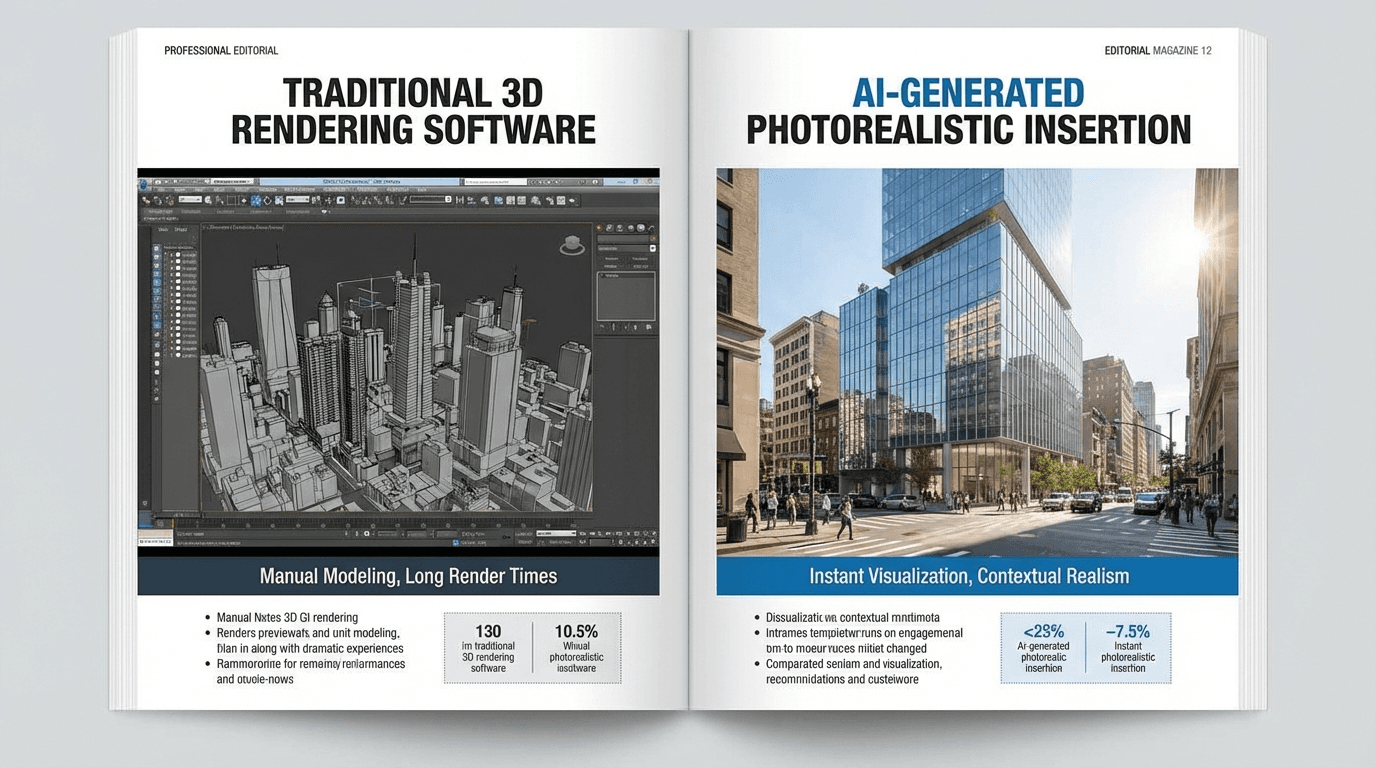
Urban project visualization has long relied on two main methods: manual photomontage (Photoshop) and full 3D rendering (V-Ray, Lumion). The arrival of AI introduces a third path that deserves objective comparison with existing approaches.
Each method has its strengths and limitations. The choice depends on the project context, available budget, and required level of detail.
Cost: decisive advantage for AI
A professional photomontage costs between 200 and 800 euros. A full 3D render with detailed environment easily reaches 2,000 to 10,000 euros. An AI visualization costs a few euros. For a project requiring 5 to 10 visuals, the savings are considerable.
This cost difference democratizes access to quality visualization. Projects that would never have had the budget for professional renders can now have convincing visuals.
Timeline: from weeks to seconds
A photomontage takes 1 to 3 days. A full 3D render requires 1 to 4 weeks. An AI visualization is generated in under a minute. This timeline difference fundamentally changes the way of working.
With AI, iterations are instant. You can test different angles, styles, and conditions in minutes instead of requesting costly modifications from a provider.
Quality: complementary approaches
In terms of pure quality, a 3D render by an expert remains unbeatable. Every material, every reflection, every shadow is controlled at the pixel level. Professional photomontage also offers an excellent level of detail.
AI quality is sufficient for most professional uses: presentations, competitions, marketing. It is particularly effective for overview shots and real-context insertions. For very detailed facade or interior visuals, traditional methods remain relevant.
Flexibility: AI's major asset
Flexibility is AI's strong point. Changing the viewing angle, modifying lighting conditions, testing different vegetation options: everything happens in seconds. With traditional methods, each modification represents additional cost and delay.
This flexibility is particularly valuable during the design phase, when the project evolves quickly and visuals must keep pace with decisions.
Recommendations by context
For early project phases and standard communication, AI offers the best quality-price-timeline ratio. For flagship project visuals or final images for high-end marketing campaigns, a professional 3D render remains justified.
Combining both approaches is often the optimal solution: AI for quick exploration and communication, 3D rendering for definitive visuals at key project moments.